China's Game-Changing J-36 Stealth Fighter: Revolutionizing Aerial Warfare With Its Innovative Design
"China’s J-36 isn’t merely a fighter aircraft; it’s a clear declaration of its commitment to pushing technological boundaries," notes seasoned aerospace journalist and stealth specialist Bill Sweetman. The unveiling of this advanced stealth fighter left observers astounded when it made its maiden flight on December 26, 2024. Featuring a tailless flying wing configuration, a tri-engine layout, and cutting-edge stealth capabilities, the J-36 promises to transform conventional aerial warfare paradigms and reshape global power dynamics in terms of air supremacy.
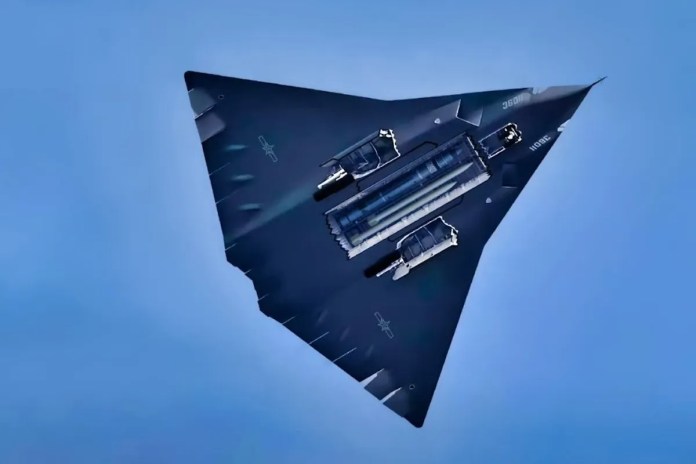
The largest combat aircraft in China and the second-biggest globally over the last three and a half decades is the CAC J-36 from Chengdu Aircraft Corporation. This highly advanced jet boasts stealth capabilities, supercruise speeds, minimal radar signature, and exceptional aerodynamics. Its distinctive double-delta and diamond-shaped wing design provides unparalleled aerial prowess. The absence of vertical stabilizers aligns it with cutting-edge fifth-generation stealth designs, ensuring comprehensive low observability across all aspects. According to Bill Sweetman, "the Boxer excels in stealth, velocity, reach, and payload," making this multifunctional platform adept at saturating adversary airspace.
The J-36's melodramatically common trait is its fervent three-engine setup, markedly deviant from typical tactical fighters. These engines draw air through a distinctive side-dorsal intake system designed to enhance both thrust vectoring and heat dissipation efficiency. According to knowledgeable speculation, pilots believe the third engine might facilitate supersonic cruising at speeds exceeding Mach 1.8 without relying on fuel-intensive afterburners. This innovative design may incorporate differential thrust control, allowing enhanced agility independent of traditional stabilizing tail fins.
The airframe is quite large, measuring approximately 22 to 26 meters in length and 20 meters in width, which means the plane must be designed for extended flight durations. It needs internal compartments capable of carrying advanced weaponry including the PL-17 missile, precision-guided munitions, and hypersonic weapons. The J-36 is a stealthy, high-capacity, long-range multifunctional combat aircraft suited for both aerial dominance and ground attack roles. Defense analyst Justin Bronk aptly put it: "This dependence on manned craft like the J-36 underscores their ongoing importance in battle zones where electronic countermeasures might disable unmanned vehicles." This was stated in an interview with the EurAsian Times.
The ramifications of the J-36 extend further than just technological advancements. Their rollout aligns with the U.S.'s debut of the F-47, another sixth-generation fighter currently being developed through the NGAD initiative. According to statements made by ex-U.S. President Donald Trump, the F-47 is nearly undetectable by radar and he claimed that "no other aircraft globally can match up." These concurrent releases of advanced fighters have intensified the competition between China and the U.S. over aerial supremacy. Experts speculated that the accelerated manufacturing schedule for the J-36 could see them ready for operational use possibly as soon as 2028, which might confer a significant strategic edge to China in the Asia-Pacific region. This situation carries substantial geopolitical consequences.
The J-36’s extended operational capabilities for missions across vast distances such as those found in the South China Sea align well with China’s overarching defense goals. With its substantial payload capacity and stealth features, this aircraft can effectively engage high-priority aerial and maritime targets, including enemy carriers and land-based facilities. According to Sweetman, "Boxer might deploy large numbers of loitering weapons against airstrips, even targeting remote sites where long-range B-21 bombers may be stationed." These expanded functions push traditional bomber and fighter jet roles beyond their conventional limits, fundamentally altering concepts of air supremacy. Despite these advancements, however, the J-36 faces certain limitations. Equipped with three engines presents challenges related to both heat management and maintaining low observability, particularly at supersonic speeds. Additionally, sophisticated flight-control systems and vectored-thrust technology are essential for stabilizing and maneuvering the craft properly. Currently, the aircraft continues to undergo refinement; recent testing indicates ongoing developmental phases.
The J-36 design also showcases China’s growing prowess in aerospace engineering. As Sweetman aptly stated, "Those accusing Chengdu Chief Engineer Yang Wei and other Chinese designers of merely replicating designs should reconsider their stance." This aircraft pushes boundaries with advancements in stealth technology and aerodynamic performance instead of simply imitating earlier models. As the J-36 moves forward from testing into pre-production stages, its impact on international defense strategies will undoubtedly unfold over time. Whether this represents a significant gamble or marks a revolutionary leap in technology remains to be seen. However, one certainty exists: the race for dominance among sixth-generation fighter jets has begun, and the J-36 is making waves as part of this intense competition.
Comments
Post a Comment